

The operators getting the most out of AI this year have quietly stopped talking about it as a tool they use. They talk about managing it — gating its decisions, reviewing its work, filing its tasks, and stepping in only when it goes off the rails. The vocabulary has shifted from using software to running a team, and the people furthest ahead have built real systems to do it.
What follows are notes from this week's Executive AI Roundtable discussion, shared under the Chatham House Rule. Names and identifying details are stripped; the ideas are preserved.
Manage AI Like a Colleague, Not a Command Line
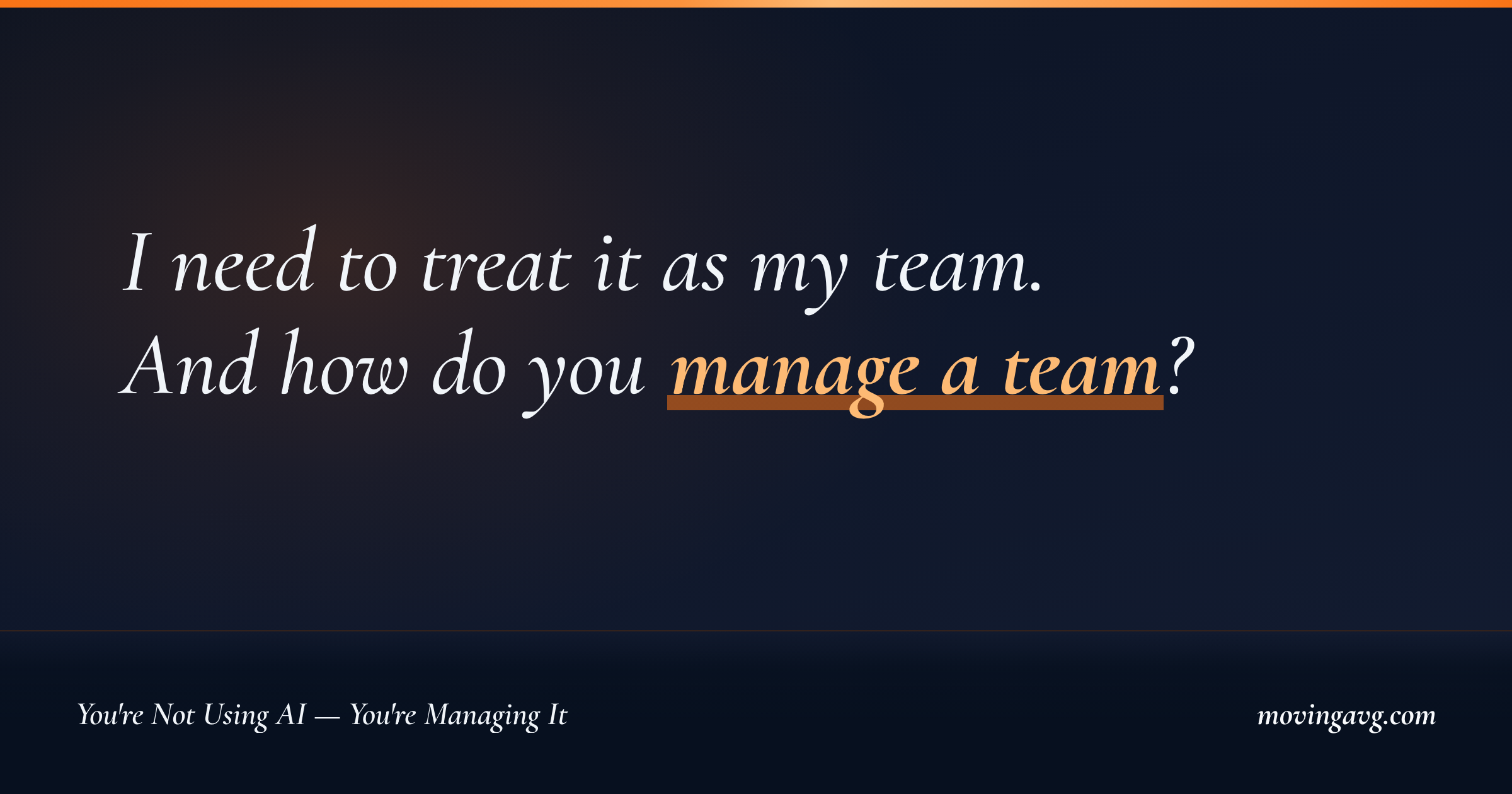
One operator running roughly thirty projects at once described the turn plainly: "Let's grow it to the point where I no longer can treat it as a tool. I need to treat it as my team, right? And how do you manage a team?" They run that many projects deliberately, to force themselves off the work and onto the process: "I'm sort of doing it deliberately to keep on adding projects to push me to not work on the project, but to work on the process that allows the whole thing to run."
The system underneath is built like an org, not a script. The operating model lives in its own git repository that holds the shared skills every project draws on. Agents coordinate through what they call an "inter-office memo" — mechanically, "all it's doing is putting a GitHub issue in somebody else's" repo. The operating-model repo is the primary recipient; memos pile into a queue that a later "graveyard shift" run works through: "next time around… I say, hey, let's do a graveyard shift. It has this queue of stuff to work on." This is the same async pattern behind running AI on the graveyard shift — the human sets up the work and the AI grinds through it unattended.
The reframe matters because it changes what you're even trying to do. "That's really, I think, the cutting edge of AI," I said in the session — "being able to really delegate to an AI system, and only have to intervene when things go off the rails." Reading every line the machine writes doesn't scale; as one attendee put it, "not even Uncle Bob is advocating for that anymore." What you're managing isn't quite a person and isn't quite a tool.
One operator reached for Kate Darling's The New Breed, whose thesis is that people relate to robots the way they relate to animals — a third category between machine and colleague. The management posture that follows looks, in their words, "much more like the management of a white collar workforce."
AI Workshop for CEOs
Where to gate an AI's decisions, what to review, and when to step in — the operating discipline that turns a fleet of agents into managed output instead of a mess. Three hours live with a small group of eight CEOs, plus a 1-on-1 to apply it to your stack.
Reserve Your Seat →Build a Review Loop That Can Say "Start Over"
If AI is doing the work, the review step is where quality lives — and a review that shares the worker's blind spots isn't much of a check. I built a Claude Code skill called Impasse around that problem: "I took an idea I got from you about having basically another lab review my AI's work, so Codex, reviewing Claude code." The point is provenance — the one requirement that makes it cross-lab adversarial review rather than a second opinion from the same blind spots. A model from a different lab fails in different places, so its agreement carries information and its objections are worth reading.
The discipline is evidence, not opinion. "I said I want it to be evidence-based, so… either Claude or Codex would have to present evidence that, hey, this is wrong." Most findings resolve before I ever see them; only genuine deadlocks reach me. "Occasionally there's something where the two cannot agree, and then I get the answer, make the final decision, which is not only super valuable, it's quite educational." I built it by dogfooding — "I ran the skill on the skill while editing the skill" — and it has become "a critical piece of infrastructure, because now so much of that quality review stuff is done by the time I see the final output." The field story of what a rival reviewer catches is in AI's Second Opinion.
A review loop also needs an escape hatch. One attendee found that a reviewer with only two verdicts — approved or blocked — traps the AI in patch loops: it fixes the flagged thing, breaks a neighbor, and grinds. Worse, "AI is perfectly happy to say, oh, that's a wonderful piece of feedback. I will now implement that," rather than stepping back. So they added a third verdict — "reshape" — triggered not by any single objection but by the pattern: "the very fact there have been these back and forths… is a significant smell. That we need to just reshape this." Reshape tells the agent to throw the work out and start over. The effect is that the system "works harder" instead of dumping the problem back on the human: "we couldn't figure it out. We're going to try it differently."
Make the AI a Producer, Not a Ghostwriter
The instinct with a creative tool is to hand it the creative work. The operators getting durable value do the opposite: they keep the parts only a human can do and delegate everything around them. A founder rebuilding a video practice drew the line hard — "I don't want it to write for me and I don't want it to come up with the ideas" — and pointed the AI at the machinery instead.
That machinery is a three-tool stack. An MCP connection drives the video editor (Descript) programmatically. Computer use handles the buttons the MCP doesn't expose — and, more than anything, it waits: "a lot of the job of the computer use actually has more to do with waiting for stuff to happen than actually doing anything that's particularly complicated." And vidIQ's free-tier MCP flags a weak title and other engagement gaps. That same computer use handles the tail end too — uploading the finished video, setting the thumbnail, filling in the metadata — "stuff I don't really want to have to bother myself doing, or learning how to do." The AI runs as a producer, not talent: "the producer has a job asking the questions and the on-air talent is the ones trying to answer them." It researches what the market wants, cross-references the back catalog for what the creator actually makes, and validates a topic by generating a draft thumbnail before anything gets filmed.
One voice-control rule applies to any AI-assisted writing, not just video. Left alone, AI smooths your phrasing into competent mush. Their standing instruction: "I don't want you to use your words. I don't want you to clean up my words. I want you to use my words. And if my words aren't doing the job, you need more words." They talk at length on purpose, because the talking is the script — "by talking at length, not only do I give it better instructions, I give it my words. That becomes more of the script." Every mistake becomes a rule: "each time we do something wrong, I'm saying, let's memorialize that, let's turn that into our SOP." The goal is to take their hands-on time for a marginal ten-minute video down to thirty minutes, with the slow work running unattended: "it's sufficiently asynchronous… I'll just let it rip."
Speed and Savings Are Different Purchases
AI is an accelerant, not an efficiency play — "you're not necessarily saving money by using an AI. You can move faster." Most cost models get that backward, and buying speed often raises your costs.
A SaaS company that leaned hard into AI code generation didn't shed engineers — it went the other way. If I'm remembering the number right, it went from one quality engineer to seven: a significant increase in cost, because the AI was producing so much output that one person wasn't enough. The bottleneck moved downstream, to everything that has to check the flood: review, testing, and continuous integration that now "takes 30 hours to execute if I let it run linearly instead of in parallel." And if your own product has AI features, those evals "aren't fast" either. The decade-old dream of pushing to production on every pull request starts to look expensive: "maybe those days are over." The upside is a hiring signal worth naming for your own team — "if you're a good quality engineer, your skills are going to be in high demand in the future, as more and more companies accelerate the amount of code they're generating."
And the real reason a lot of this work happens isn't on any spreadsheet. As one attendee put it: "Because it's fun, and we like just watching the screen scroll when we type into Claude. That's the honest reason why a lot of this stuff's happening." That's not a knock — enthusiasm is why teams learn fast. But if you're greenlighting an AI project, know whether you're buying speed, buying a capability, or buying the fun of watching it work, because only two of those show up in the numbers. More on the gap between motion and outcome in AI productivity versus value.
The SaaSpocalypse Is a Moat Story
A running debate in these rooms is the "SaaSpocalypse" — the claim that customers will simply "token their way to no more SaaS bills." I'm skeptical that plays out cleanly. "Things sometimes seem like a commodity when they, in fact, really aren't a commodity," and there's more to a software business than the software: "you've got sales, you've got marketing, customer support, brand." My favorite illustration is Dump Truck Dispatch, a specialized vertical tool — the people operating dump trucks "are not gonna token their way into a replacement for dump truck dispatch."
But the bar is rising. As one attendee put it, "you can't just have basically a spreadsheet with some UI slapped on top" — because "somebody else sees that, then they're gonna come and do it for $99 a month." Your "moat is thinner." The cheaper it gets to build the thing, the harder it is to command a premium for it, and the domain expert who used to be priced out of building can now afford to: someone who understands the vertical and "is under 40 years old… very likely have some kind of coding experience."
These are often still fine businesses — it's the premiums that evaporate: "I think the real SaaSpocalypse is for the investors," because "the profits are getting sucked out of them." That changes the whole strategy question. If AI can compress your feature's cost to near zero, the threats multiply: the customer who could rebuild it, the competitor who launches the same thing cheaper, and the big lab that might ship it as a feature. One founder racing exactly that dynamic put their whole strategy in a sentence: "my only hope is that I launch before they do." The practical response to a customer who could rebuild your product is not to panic but to sharpen what isn't cheap to copy — the argument in the vibe-coding objection.
Make the Probabilistic Parts Deterministic
The flip side of managing AI like staff is that staff are probabilistic, and some steps can't be. One builder described a flow that would "randomly queue stuff up for that cloud session that doesn't exist" — the non-determinism was a correctness bug, not a rough edge. The fix is to borrow determinism from software. Skills can carry code, not just instructions — "skills are not just prompts, they can include software and scripts" — and Claude Code exposes hooks: "you can literally add hooks to different stages in the prompt flow that'll be like that software deterministic thing." Wrap the step that must not be skipped in a script or a hook, and it stops being a coin flip.
The same builder had already found the concept the hard way, boiling The E-Myth down to its usable core: "checklists are good… none of this stuff is gonna help at the end, you need the checklist." A checklist a human runs is a habit; a checklist a hook enforces is a guarantee.
The maintenance discipline that keeps the whole thing improving is a single reflex: when the AI frustrates you, don't just fix the output — make it investigate the cause. "My advice is whenever it frustrates you, tell it to go investigate. Why did this happen? How can we improve it?" Point it at its own instruction files, have it propose the change, and keep yourself in the approval loop: "you don't have to do it automatically, but you tell it to change it, and you make sure it makes sense." Over time, the review of the AI's context becomes part of the AI's job — the feedback loop that closes on itself.
Where to Start This Quarter
- Pick one workflow and manage it, don't just run it. Define what the AI decides on its own, what it must gate to you, and what "go off the rails" looks like — then step back to only that.
- Put a rival on the work. Add a review step from a different model or a different lab, demand evidence for every objection, and route only genuine deadlocks to a human.
- Give your review loop a "start over." When you see the same fix-and-break pattern twice, stop patching and tell the AI to reshape the whole approach.
- Delegate the machinery, keep the judgment. Hand the AI the slow, mechanical work around a creative task — the uploading, the waiting, the formatting — and guard the part only you can do.
- Buy the right thing. Decide whether an AI project is buying speed, a new capability, or fun — and staff the downstream review before the output floods it.
- Make the must-not-fail steps deterministic. Move the steps that can't be probabilistic into scripts and hooks; leave judgment to the model.
- Turn every frustration into a fix. When the AI does something you didn't expect, have it investigate its own instructions and propose the change — then approve it yourself.
Resources From the Roundtable
- Claude Code — the coding-agent environment behind most of the operating systems described, including skills, hooks, and the multi-account Max workflows.
- Impasse — the open-source cross-lab review skill: a model from a different lab reviews the work, must cite evidence, and escalates only genuine deadlocks.
- Descript — transcript-based video editor with an MCP server; the editing engine in the AI-producer pipeline.
- vidIQ — YouTube optimization tool whose free-tier MCP server flags weak titles and other engagement details.
- fastlane — the mobile-release automation cited as the model for stacking slow processes and letting them run unattended.
- The New Breed by Kate Darling — the argument that we relate to robots like animals, a third category between tool and person.
- The E-Myth by Michael Gerber — the checklist-and-systems classic invoked for why deterministic process beats heroics.
- TinySeed and MicroConf — the bootstrapped-SaaS communities behind the moat and SaaSpocalypse debate.