Executive AI Build Founding cohort
In four weeks, one of them won't be. Build one AI process with the person on your team who will run it.
Bring one process your team does by hand, such as onboarding, support replies, sales prep or reporting. You and your process owner, the person who will run it, improve it over four weeks, with my feedback each week and a small group of software CEOs building theirs alongside you. You leave with a working AI process your team owns, a written guide to running it, and the experience to lead the next one.
 Led by John Knox, host of the Executive AI Roundtable, who has automated many of his own business processes with AI.
A free 20-minute call. We'll review the valuable processes your team still does by hand. Based on what I've seen work for other software CEOs, I help you pick a process that fits four weeks and name your process owner. Then we see whether Build is right for you. If it is, I send you the enrollment details after the call.
Book a free 20-minute call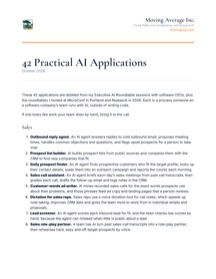 When you book, I send you 42 Practical AI Applications, distilled from my Executive AI Roundtable sessions and the roundtables I hosted at MicroConf in Portland and Reykjavik.
Eight seats. Book your call by Monday, November 23.
"John brought together a group of people for a 1 hour call that provided more value than a week's worth of one-off conversations."
"What's working and what isn't, without all the hype."
"It's an inside track on what people are experiencing in their organizations."
"I learned so many practical use cases from my peers in a very short amount of time."
From my AI roundtables. Build's founding cohort starts January 19, 2027.
You use AI to work in your business, not on it. You know it could take on real work, but it stays where it started: in your chat window, on your plate, while your team still does that work by hand. You become the bottleneck for AI in your own company. In a company of a few people, that is most of the company's AI. What matters is a process that works and moves your business toward its goals.
The practices that work are lost in the hype and the noise. Build is focused on practical results, and it draws on what I've learned automating my own business and advising and mentoring founders. You do the work with a small group of leaders doing the same.
Build moves the responsibility for the work to your team.
You learn to lead this work by leading one real project with your team. The person who will run the process builds it with you, so it is theirs from the first week. You don't end up with one more AI tool that only you can fix. That project is a first step toward a team that builds with AI.
You use AI chat to help with business work as it comes up.
Where you startYou and your team break a process into steps AI can repeat, and start testing them.
The process runs in production. Your team owns it, maintains it and keeps improving it. You stay accountable for it.
Where you finishBuild gives you a repeatable way to improve your team's processes with AI, one at a time. The first project teaches your team the method, gives your process owner the experience of running a process with AI, and gives the rest of your team a working example. On demo day, you name the next process and its owner, and your first process owner shows the new owner the method. About six weeks later, you review your plan for the next process with me at the follow-up.
John Knox has spent more than 25 years building products at technology companies and advising them. Since March 2026, he has hosted more than 20 AI roundtables with CEOs and founders of software companies, including the AI-in-business sessions at MicroConf in the US and Europe.
After the roundtables in Reykjavik, founders told him what had helped: seeing what their peers were actually doing with AI, and measuring their own results against that. Build grew out of those conversations.
He directs AI in his own business every day. An AI chief of staff runs his briefings and follow-ups, and an SEO auditor keeps a log of its own experiments. Other automations turn meeting transcripts into blog posts, prepare social posts and personalized email to his list, and handle IT tasks. The method in Build is the one he uses on them. He has also helped other founders do the same, at his roundtables and in his advisory work.
Results founders and CEOs have reported from using AI in their businesses.
A software company says AI cut its customer onboarding time by about 70%, by moving new customers' data out of their old systems.
A small company estimates that its internal knowledge agent now answers about 75% of staff questions before anyone has to ask a person.
A sales team that refused to use AI started by dictating call notes. The founder estimates conversion rose 10–12%.
A founder reports search clicks rose from almost none to about 1,000 a day, with pages built from AI-assisted research.
A founder built a product template site in 2 hours. A year earlier, a designer had quoted about €15,000 for it.
An agency founder reports producing a campaign in about 30 minutes, down from almost 20 hours.
Each started with one well-scoped piece of work. Build is where you pick yours, or bring one you've started.
Figures are the participants' own reports and estimates.
One process that matters to your strategy, improved with AI by you and your team, tested on real examples from your business, and ready for your team to run. If you bring a tool you've built, you leave with its next version.
Measured against the way the work is done today, by hand or by your current version, with a record of how it reached each result.
Written by the person who owns the process: how to run it, check its results, and fix it when they get worse.
A short written check-in every Thursday, and a group expecting to see your progress every Tuesday.
When you book, I send you 42 Practical AI Applications.
Every live minute goes to your project, with the group. The ideas come as short reading and video before each session. Between sessions, you and your process owner do the work.
About 3–4 hours between you and your process owner, depending on the process. Together, measure the process today and gather real examples.
Confirm your process with the group, and list what it needs (systems, data, access) from your process owner's notes on the preparation form. 90 minutes.
A plan the group has challenged, with my written feedback first. Your process owner gets my feedback too.
On Monday, I post a written read of your process owner's results in the channel, and they answer my questions. In the session, the group helps you get more from the process and work through what is still in the way: a step that fails, a system you can't reach, a team member who would rather not.
Your process owner shows the working process and the guide to running it. You name your next process and who will own it.
How your team ran it, what changed, and your plan for the next process.
Founding price for you and one process owner, for this cohort only. Later cohorts pay the full price. Compare $2,500 with the hours your chosen process takes each month today.
When you book, I send you 42 Practical AI Applications.
Full refund, for any reason, until the first session on January 19. After that, if you can't continue, your seat moves to the next cohort.
Lessons are shared under the Chatham House Rule. Everything about each other's businesses stays in the group. Sessions are transcribed, not recorded, and the transcripts are deleted 30 days after the follow-up. Please don't bring AI note-taking bots.
What we learn about building and using AI tools is shared under the Chatham House Rule: use it freely, but don't say who said it or where they work. Everything about each other's businesses (product plans, customers, sales numbers, revenue, data and internal processes) is strictly confidential and stays in the group. Any implementation detail of a member's AI tool that they ask to keep private stays private.
Under that rule, I may write about methods and lessons from the sessions without names. I'll ask before using anything more specific about your business or your AI tool.
Sessions are transcribed, not recorded. Transcripts are cleaned of confidential details, shared only with the leaders in the group, and deleted 30 days after the follow-up session. Please don't bring AI note-taking bots.
The same rules cover the members' channel and the follow-up session, and they bind process owners in their channel, at the kickoff and on demo day.
The roundtable is an open conversation, shaped each time by the people there. Build is focused on one outcome: one working AI process, owned by your team, with accountability, feedback from your peers and from me, and an exclusive group to learn in.
No. Neither of you needs to code. Claude does that part, and the preparation tells you what to ask it. You both need to be comfortable using a computer and following detailed technical instructions from Claude, such as setting up an account or connecting a system. You also need access to the systems the process uses.
Yes, if what you've built still takes too much of your attention. Often the founder who builds an AI tool ends up maintaining and running it. Part of a process your team used to run now runs through you. The company may be more efficient, but you have less time, and your team misses the chance to learn to work with AI. Bring the tool instead of a blank page. You and your process owner spend the four weeks measuring it on real examples, fixing what fails and cutting down the work it still needs. By demo day it belongs to your process owner: they run it, they keep improving it, and they wrote the guide to running it.
One recurring process where you can gather real examples: onboarding, support replies, sales prep, reporting. If yours is too big, the week 1 session helps you narrow it to a piece you can finish in four weeks.
Keep it where it is, or move it to Claude. Your choice. The method works in any product: real examples, a clear picture of what good output looks like, a record of what each step did, and a guide to running it. In another product, you ask its AI the same questions the preparation asks of Claude.
You'll get the cleaned transcript, and your weekly check-in keeps you on track.
Your process owner works on it with you between sessions, in their own channel with me and the other process owners, and joins live on demo day to show the process. The Tuesday sessions are for leaders only, which keeps them a peer group.
The same preparation materials you get. A process owners' channel from January 4, with me and the other teams' process owners: on Mondays they say what they will run that week, on Thursdays what broke and what worked, and I reply within two business days. An optional 30-minute live kickoff with me on Tuesday, January 12. My written feedback on your plan. On demo day they show the working process and the guide to running it, which they wrote. By then the process is built to take less of their week. They also gain hands-on experience improving a real process with AI, the kind of career growth people now want from their job.
It depends on how complex your process is and how far you want to take it. As a guide, you spend about 2–3 hours a week: the one-hour session, 15–20 minutes of preparation, and about an hour with your process owner. Your process owner spends about 4–8 hours a week building and testing it, in short blocks spread across the week: running real cases through it, checking the results and adjusting it. That includes two short posts a week in the process owners' channel, and demo day. Before the start: about 30 minutes on the intake email, then about 3–4 hours between mid-December and January 15, shared with your process owner.
It can be. Build is designed for a leader and one team member. If you work alone, you can join and do both roles, about 6–10 hours a week. The guide to running your process becomes your operating guide, and the brief for your first hire. Book a 20-minute call first, and we'll check whether now is the right time for you to join.
An agency can build you a tool, then leave your team to maintain it, no better prepared for the next one. Build leaves your team with a working process it owns, you with the experience to lead the next one, and a plan the group challenged before you built it.
You can. The hard part is usually time, not skill. A strategy has to say what you will stop doing, and improving a process means setting some normal work aside for a few weeks. Regular work usually looks more urgent than work that saves time later, so the project waits. Build gives your team a reason to set the time aside: a fixed end date, a method, my written feedback on the plan before you build, and a group that expects to see progress every Tuesday.
Some of the hardest parts of adopting AI have nothing to do with technology. They are about culture, managing people and leadership. The other leaders look at your company from outside it, and they bring what has worked in theirs, not what social media says AI can do. The Tuesday sessions are leaders only, so you can say what isn't working, including with your own team, to people facing the same problems. You still get my review of your plan and your finished process. One to one is my advisory work, and it costs more.
Yes. Buyers pay less for a business that depends on its owner, and an AI process only you can run or fix is one more thing that depends on you. Build ends with your process owner running and maintaining the process, using the guide they wrote.
Your AI work runs in your own AI account. What you share with the group and with me is covered by the confidentiality rules.
Bring one part of your business. Improve it with your team, alongside other leaders doing the same. Leave with the experience to lead the next one.
When you book, I send you 42 Practical AI Applications.
